
Fitness Coordinator and GB triathlete Claire Bloom, who is sponsored by GRAVITY UK and David Lloyd Leisure, has won the bronze medal in the 50-54 Age Group Sprint at the ETU European Triathlon Championships in Alanya, Turkey, which took place … Continue reading
Pomegranate juice’s therapeutic benefits
Gallery
Pomegranate juice (PG) was recently studied in a randomized placebo-controlled trial conducted by the Nephrology Department of the Western Galilee Hospital, Israel. The study showed an increase in innate immune function and a decrease in the progression of the atherosclerotic … Continue reading
Not all Balls are created Equal –
Gallery
Over the past 15 years I have taught quite a few swissball classes – strength /pilates / pregnancy and used them extensively for Personal Training and in my own workouts and I have used many different brands of swiss balls. … Continue reading
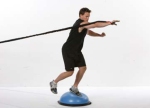
BOSU – Balance for Tennis Performance
Gallery
This gallery contains 3 photos.
Written by Douglas S. Brooks, MS & Peter Twist, MSc The systems, strategies and tactics in tennis are best described as organized chaos. During a match, no competitor – even those with great on-court intuition – knows exactly what will … Continue reading
FIT JOINTS Series #3
Reply
by Dr. Theresa Dobson.
PART THREE OF THE “FIT JOINTS” SERIES
Introduction: Let’s begin with your posture.
STAND YOUR GROUND!
I literally and figuratively mean that. Posture is everything. How you stand and each step you take affects every joint in your body from the top of your head to the tip of your toes and all that lies in between. And here is why.
Gravity rules!
The minute we become bi-ped gravity begins its journey of push and pull down every joint in your body. Your platform for balance is your feet. They have the task of balancing your whole body upward against gravity keeping you from toppling ove. This alone seems an amazing feat not to mention the demands that occur when you decide to engage in multiple movements that sports and life require. Your body has built in mechanisms via the nerve system and joint system to accommodate your multi-directional demands quite gracefully – if your posture is intact. When your posture breaks down, uneven loading to your joints and spine begin – and injury and pain follow close behind.

So let’s explore the mechanisms of posture.
Ground Control:
Years of experience and thousands of postural assessments lead me to your feet. They reveal the secrets to how you stack upwards. Posture begins from the ground up, but can confront major challenges in today lifestyle which continually contract you down and forward such as computers, driving, cell phones, reading etc… These all force you into a forward contracted posture giving gravity momentum creating excessive loading and compensation through and including your organ systems all the way down to your toes.
Example; a minimal forward drop of the chin 2 centimetres equates to your normal 10 -12 kilo head weight becoming 17+ kilos (this commonly occurs while sitting at a computer). To ensure you don’t fall over with this additional load, the neck, shoulders, spine, hips, knees and feet all compensate and counterbalance this extra load. The longer the head maintains forward load, the harder the muscles and joints have to strain to maintain.
What a waste of energy!
Most jobs and sports require imbalanced loading to one side of your body making proper posture complicated and stressful to your whole system. Simple postural exercises can prepare your body to deal with these stresses and restack you evenly. Get your postural assessments from a professional and the rewards and benefits will last a lifetime.
Fact:
The foot has 26 bones, 33 joints, 107 ligaments and 19 muscles. WOW that is impressive! The toughest strongest and largest tendon in the foot is the Achilles, making it the longest and toughest to heal after injury. Those who have experienced this know it’s a big “Boo Hoo”! There are 125,000 sweat glands in each foot – yikes! So let those puppies breath!

Joint of The Month: The Foot / Ankle
The most frequently injured joint from sport is the ankle. The most common ankle injury occurs as the outside edge of the foot rolls over itself, lifting the arch of the foot and in turn tearing and damaging the outer ligaments.
Reoccurrence of foot and ankle injury is very high! Your feet must be rehabilitated properly to prevent this.
 Create happy feet and prevent or rehab injury by training and stretching your feet in multiple directions and movement patterns. Yoga is great for this. Pick tramps with undulating terrain which challenge all angles.
The beach is also ideal. Kick off those boring shoes and do ABC’s in the sand (alternating heels and toes). Twirl and twist your feet in the sand – and give them a natural foot massage!
Dropped arches are a red flag to get yourself to a podiatrist where shoe inserts will assist.
On The Need to Know List:
“The World is Flat”. At least that is how your feet would interpret the western world of today – “A Flat Concrete Jungle!”
The amazing blueprint of your feet is designed for the ability to traverse across uneven terrain, stones, boulders and steep hills whilst keeping you stable and mobile. Today’s flat shoes and flat concrete jungle offer no challenge to the unique abilities of the feet and their intricate design.
The once “happy to meet a challenge” feet have now become lazy, collapsed, sore feet. When you take them for a walk, run or sporting event that slightly veers from flat you quickly find yourself with an injury.
So be kind to your feet and be playful with your feet – because they have the big journey called “Your Life” to carry you through!
Fusion:
Sport offers you the gift of “complete presence” therein lies its sweet addiction and soul satisfaction. Your body gets to engage in the timeless space called “The Now” free of life’s tangles. Don’t let your busy calculating mind impose itself! Direct your mind as the tool in your sport, and let your body becomes the sport.
Next month’s FIT JOINT Series article will focus on the Hip.
Dr. Theresa Dobson
Doctor of Chiropractric, Neck Specialist, Neuromuscular Therapist, Biokinetics Practitioner, CHEK Holistic Lifestyle Coach Level II, Sports-Specific Practitioner and Seminar Presenter, Dr. Theresa Dobson has a long-standing rep utation as a highly experienced and knowledgeable practitioner. With two clinics located in Auckland and on the North Shore, Theresa works with a wide spectrum of patients such as professional rugby players, boxers, surfers, yachtsmen, cyclists, motor racers, soccer players, as well as recreational sportsmen and women of all age groups. Theresa is currently setting up a new business, guiding people through the “Dos and Don’ts” of surgery, offering programs and seminars to advise patients how to manage their pain effectively.
www.activecare.co.nz www.stitchedup.co.nz
Theresa Dobson welcomes your emails at info@activecare.co.nz
FIT JOINTS Series #2:
by Dr. Theresa Dobson.
PART TWO OF THE “FIT JOINTS” SERIES
Introduction: Take Me to the River.
 You wouldn’t typically think of your body as a river, though you probably should!
Your human vessel is composed of 70-80% water.
Every cellular function awaits the arrival of this liquid gold to perform the alchemy of generating life, energy and repairs that you body requires to stay alive.
Millions of chemical reactions occur every minute that require water. The joints of your body depend on water so blood can deliver much needed nutrients and escort ugly toxins and waste away.
Decreased water supply to your body is particularly vicious to your joints due to the fact that if toxins are milling around your organ system and there is not enough water to transport them to your bladder via the kidney, your body will use your joints as a garbage can for these toxins, thus detouring them away from your vital organs. This trade-off seems such a logical and smart compromise, but comes at a high cost.
Toxins stored in joints cause early degeneration with pain and breakdown close behind. Your luscious clear river has now become a swamp… Yikes!!
Hydration is one of the easiest economical ways to acquire healthy joints and a happy body overall. Grab that liquid gold and hydrate, hydrate, hydrate!
Each of you require different amounts of water based on how many cells you have, so here is an easy formula to know the right daily amount for you:
Take your body weight in kilos and multiply by .033, this is your personal perfect water intake amount.
Joint of the Month: Your Precious Knees
 The largest joint in your body is the knee.
Classified as a hinge joint, your knee is the meeting point for your shin (tibia and fibula) and your upper leg (femur) which are all joined together via a barrage of ligaments to secure this precious joint.
Without this joint we could be walking on stilt legs (very unattractive), and most sports as we know them would be impossible!
The function and health of this joint is dependent on the balance of the pulleys and levers (muscles/tendons) that attach to it.
For instance, weak hamstrings and strong quads create excessive load to the ACL (anterior cruciate ligament): the most commonly injured ligament in the knee.
Balanced muscles, healthy ligaments and good posture are critical to this joint. So get yourself assessed via a length / tension assessment by a qualified professional, physiotherapist or CHEK practitioner.
Fact:
The knee is also the most complicated joint in your body! As it is a pivotal hinge joint that allows flexion (bending), extension (straightening) and small amounts of rotation, it is a ligament-filled joint. Those of you who have endured knee injuries and surgeries know these three lettered ligaments well: ACL, PCL, MCL and LCL. Injury to this joint is the reason most people visit orthopaedic physicians. It is also the joint most vulnerable to acute injury and osteoarthritis with the ACL is the most commonly injured ligament.

On Bended Knee
Most of our available leg movements and virtually all sports activities are dependent on your knees. They also support the whole upper body – so many thanks required!
 Because your knees are in such high demand, they are also subject to a variety of injuries. In fact, knees keep most orthopaedic surgeons as busy as bees. Unfortunately many knee pre- or post-injuries are not rehabilitated properly and leave many people with the inability to fully extend (straighten) or flex (bend) your knees. This can not only be very frustrating but also compromises the rest of the body which has to compensate for your weakened knee.
Bless rather than curse your knees and prepare them for the demands you ask of them!
Because your knees are composed of ligaments not muscles, you must train and prepare them quite differently. The flat surfaces of our contemporary lifestyles provide no challenge to these ligaments and they become weak and prone to injury.
The knee should be trained in multiple movement patterns with slow held motions to excite and engage the ligaments, otherwise they can become unstable.
This joint is seriously challenged if your sport involves quick stopping or starting, changing directions or repetitive impact such as running, rugby, soccer netball, basketball, skiing, tennis or squash to name a few.
Individuals with flexible joints and hyperextension tendencies are especially vulnerable to knee problems so seek professional advise before engaging in a sporting activity.
Key Points to Remember:
- Hydrate, hydrate, hydrate.
- Train and rehabilitate to address the ligaments not just the muscles.
- Seek professional advise and have a length tension assessment.
- Get your spine checked to ensure postural imbalances are addressed.
- Visit my webpage for more information or inquiries: http://www.activecare.co.nz
Fusion:
Create your perfect sporting moment…where your body, mind and soul smile. Breath into that moment and feel the magic. Then do it again… and again!
Next month’s FIT JOINT Series article will focus on the Foot-Ankle.
Dr. Theresa Dobson
www.activecare.co.nz www.stitchedup.co.nz
Theresa Dobson welcomes your emails at info@activecare.co.nz
It’s Not About the Weight
By Josh Smith.
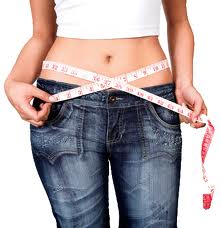 It’s not about the weight. It never has been.
And frankly, I’m sick and tired of the poor education that gets peddled in the media, in the stores, and by other so-called ‘health professionals’ (Yes thats YOU – dieticians, nutritionists, personal trainers, exercise physiologists, doctors, physiotherapists and anybody else peddling ‘weight loss’). It’s not about the weight.
Yes, some people must lose ‘a percentage of their body mass’ and sometimes a LOT of their body mass, before we can consider them healthy. But lets take a look at this for a second…
What are these people actually doing?
If they are doing things correctly, achieving ‘health’ how health should be achieved – they are bringing their body back towards homeostasis*.
They are taking their body from a toxic, stressed state to a size and shape that is normal for them, through the application of correct nutrition, training and lifestyle modifications.
 This ‘normal size‘ is different for each and every person.
It is geneticially imprinted into each of your cells upon birth, and is innately linked to the ‘primal being’ inside you, and not some misinformed, misguided and mistaken pseudo-YOU that you develop through other people’s perceptions and beliefs.
Sometimes you must gain ‘weight’ to be healthy, but this does not mean you are fat. Quite the opposite.
If you are healthy, your muscles are dense. Your blood flows correctly. Your body is quite literally a fat burning machine, using that fat as fuel to feed your ever-thirsty, lean muscle mass.
So what is it we should be focusing on?
- Body fat loss
- Energy levels
- Digestive ability
- Taste sensation
- Lean muscle mass
- Bone density
All of these things can be measured, whether qualitatively or quantitatively, and give us a much better definition of whether we are ‘healthy’ than weight loss alone could ever give us.
So what is a healthy look?
In my own personal opinion, health looks like muscle mass. Health looks like clean skin. Health means sparkling eyes, reduced body odour, and a positively energised aura.
This doesn’t come with ‘weight loss’. This comes with a complete transition of your thinking, and comes from an understanding that a fading person is not necessarily a healthy person.
Healthy people can lift things.
Healthy people can move in all three planes of motion, under unstable loading parameters (gravity, instability), WITHOUT restriction.
Healthy people have ENERGY. They GLOW. They can digest GOOD FOOD.
Healthy people don’t look for energy drinks, protein supplements, schmancy machines or substandard training regimes.
Healthy people understand their BODY, know what their body WANTS, and then GIVE IN TO IT.

So don’t think ‘weight loss’. Think ENERGY. Think MINIMISE BODY FAT. Think FUNCTION.
Think HEALTH.
And for goodness sake – DON’T sit around moping when your Lite ‘n’ Easy diet, machine-based training regime and energy drink consuming lifestyle makes you THIN and SICK.
 *Homeostasis is a state whereby the bodies’ systems are working in synergy, Yin and Yang, and that the balance of the sympathetic and parasympathetic branches of the nervous system are functioning optimally. What this means is that body fat loss is maximised, circadian rhythms flow naturally, and all muscles, organs and body systems are supplied with the right amounts of blood at the right times for repair and function, amongst other things.
It is within you.
Josh Smith
Josh is the Director of Mitise Health & Fitness, offering Personal Training, Nutritional Guidance, Lifestyle Coaching, Personal Development, Corporate Seminars, BootCamps and Boxing Groups. Josh is a qualified CHEK Exercise Coach, CHEK Holistic Lifestyle Coach Level 1 and GRAVITYPersonalTrainer, along with various other qualifications and trainings, and is a very inspirational individual. Mitise (pronounced my-ties) is a word invented by Josh and actually stands for “It is within/in Me“. Check out the spelling of Mitise and you’ll see the connection. Clever huh!
Energy…Give Me More!

By Michelle Owen.
We all want to have abundant energy to get us through the work day…and still have more to go to dance the night away!
This is one of the most common things that people want when they come and see me – more energy.
As C,H.E.K Practitioners, we never treat the disease that has the person – we only treat the person that has the disease. So for those suffering from lack of energy and its consequent disease, we teach how to embrace the Six Foundation Principles. These are:
THOUGHT, BREATH, HYDRATION, NUTRITION, EXERCISE and SLEEP.
As far as energy goes, I have written many things on the importance of breathing correctly, hydration, quality of food, postural balance, exercise and sleep.
This time I am focusing on thought.
 Thought triggers emotions. Every thought we have has a corresponding emotion, and every emotion has a hormonal and energetic reaction within our body. Hence our Psychology is our Biology.
Thought always comes first and the thought creates the emotion. For instance, if the thought is: “I don’t like my job” or, “Nobody loves me” these thoughts can cause us to feel very unhappy. Consequently our energy levels fall. The same goes for other life situations such as relationships; self image; financial status etc.
Poor thinking pumps stress hormones into our body. Over time this causes hormonal imbalances, leading to decreased energy and disease. Too much stress or poor thought of any sort will weaken the immune system, no doubt about it!
When we create what we don’t want, our energy decreases.
When we create what we do want, our energy increases.
When we are in tune with what we really want, we never run out of energy!
We are all given the same amount of life force. If people are sick or tired they still have the same amount of life force, they are just channeling their energy differently. Creating new and positive thought is the most powerful way out of this.
Pain of any sort, physical or emotional, is the compass of our soul. These experiences help to push us to make better choices to get to our higher self. The more the pain, the more we are out of alignment with who we really are.
For some people, injury or illness can be one of the most valuable things in life, maybe not in the moment, but the learning from the experience because it can be so life changing! It can lead to greater knowledge of themselves, greater health, love and appreciation of all they have in life. Quite often it is only on their death bed that people’s appreciation for life is amplified.
Wouldn’t it be far better to reach this appreciation while they are in fully involved in life?
Give yourself some energy
 Energy is like money in the bank – What are you doing to put it back? Or are you spending it all?
A lot of my clients are so busy; they squeeze things into every moment of the weekday and their weekend! This is great for productivity, but we all need to stop and refuel at certain times. Running on the fast track without rest and recovery soon leads to decreased energy, depression, anxiety, long term adrenal exhaustion, and burn out.
There are many different ways we can give energy back to ourselves (get the money in the bank). For instance:
- Meditation
- Hot baths or spa pools with oils and candles
- Saunas
- Good quality food in the right balance for your metabolic type
- Deep breathing
- Any time spent in nature
- Time with animals
- Time with good friends/family/people that give you peace
- Massage
- Soul healing work
- Pedicures/manicure/facials
- Nice energy music, movies or reading
- Good quality exercise
- Low level exercise like stretching, mobilizations, tai chi etc.
- Getting to bed before 10pm.
- Having afternoon naps
Give to yourself often, even if it is small. If you spend all your energy without giving back, you will end up emotionally and physically bankrupt.
The importance of clearing past traumas
 The human mind is an endlessly complex creation made up of the conscious/subconscious or active/reactive mind.
The subconscious or reactive mind stores every picture of our past, good or bad. This includes sight, sound, smells etc.
The reactive mind is so strong that in times of stress it takes over our conscious mind and can put us back into the feelings of past experiences. This can cause all sorts of pain physically and emotionally. It also keeps us stuck in feelings of loss, fear, anger; an endless list of negative emotions.
I believe that one of the most powerful things we can do to recreate health in mind, body, and soul is to get professional help in clearing past traumas/ experience that keep us stuck in poor patterns, repeating the same cycles. A professional will guide you along the path that best suits you, for many such paths exist. I have tried several and continue to do so. All are very powerful and each person will find a different one that works for them.
To me they are all different roads to the same outcome of cleaning up rubbish in our minds.
Michelle Owen
Michelle is a C.H.E.K Practitioner Level 3 and CHEK Holistic Lifestyle Coach Level 3. With a successful studio in Auckland, New Zealand, Michelle works as a Postural and Wellness Specialist, Lifestyle Coach and Practitioner. She also offers onsite Corporate Wellness Seminars and has spoken for a number of corporate companies including Hyatt Regency, Kensington Swan and ANZ Bank. As a Key Note Speaker, Michelle is passionate about bringing the CHEK principles to people everywhere.
www.michelleowen.co.nz
www.stitchedup.co.nz

FIT JOINTS Series #1: Atlas “The Master Control Centre”
Introducing a new contributor to the HQH Fitness blog – Dr. Theresa Dobson.
PART ONE OF THE “FIT JOINTS” SERIES
Introduction
 Let’s have a look under your skin. OOOUCH!!!
No doubt you have spoken that profound word (amongst others) when you have engaged in the journey of a joint injury. Most of us have and this is not surprising considering life in the 2011’s requires most of us to be endurance athletes in and out of our work environment:
We wake to an alarm, toes to carpet and we’re off rushing in to the new day.
Combine that with the fact that most sports, jobs and hobbies (both recreational and professional) require that we use our bodies in very imbalanced and repetitive movement patterns…and our bodies will be sure to remind us of it at the end of each day!
Years of experience as a Chiropractor, Sports Practitioner, and having the delightful challenge of working with professional athletes, coaches and trainers in the full spectrum of sports has taught me that most joint injuries occur within a very small range within the joint – generally when a joint is taken past its normal end range of motion to the minute amount of 0-4 degrees.
Indeed this sounds quite ridiculous!
However, when you understand the intimate relationship of the body’s “playful threesome”:
Tendons + Ligaments + Muscle
which make up the basic foundation for joint movement, you too will become intrigued at the intimacy of this relationship.
So…lets take a peak beneath our skin!
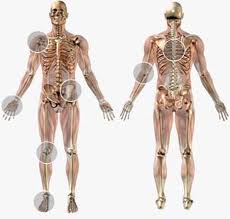 FACT: There are 206 bones in the human body (note that this number will vary slightly for those special genetic off throws). In order for these eager bones to move and perform for us, they require the assistance of the “playful threesome”. This threesome literally become the pulley and lever system for the bones. Quite honestly it is like a game of puppetry. Without this pulley and lever system we wouldn’t be much more mobile or interesting than a sea slug!
Here is a user friendly version of the threesome:
- Ligaments are strong fibres (like thick fishing lines) binding bone to bone, allowing and limiting motion and providing attachment sites for muscle tendons.
- Tendons are fibrous tissue (again like fishing lines) connecting muscles to bones.
- Muscles are tissue made up of contractile fibres ( like elastic bands) that effect and create movement of bones.
So in short, as the muscle contracts, it shortens. With support of the tendon attachment to the bone it levers the bones in different directions depending on the joint type and shape. Ligaments secure, protect and hold bones together. This “threesome” allow our body’s the joy of movement!
So to keep a joint fit and healthy, we must keep it within the range of motion dictated by the joint shape and function as well as the ligament’s protective grip.
Joint Injuries in Relation to Sports:
 Most sports force imbalanced muscle demands, demands which twist us one direction, loading one side of our joints, ligaments, tendons and muscles. This creates uneven contracted strong muscles on one side and weak, loose muscles on the other, in turn putting tremendous stress across the joint which ripens it for injury.
Then an athlete takes this stressed joint out to play and the slightest 0-4 degrees of unfamiliar movement or impact punishes the joint or muscle. In turn this angry joint punishes you!
A postural / length tension assessment can reveal and correct imbalances, but should be done by a qualified practitioner.
Not so FAQ’s…but on the “need to know” list:
Muscles heal quicker than tendons/ ligaments as they hog large amounts of blood (which contains the jewels of healing), whereas ligaments/tendons get very little blood and heal slowly (Zen patience required!).
JOINT OF THE MONTH:
This month I will address the most important joint – the top of the spine is top on my list.
“The Master Control Centre” – C1 (Atlas Vertebra).
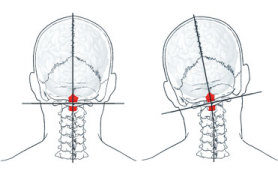
Located just behind your earlobe, your atlas is a 2-ounce bone at the top of your neck that is responsible for supporting the weight of your head – which can weigh between 9 and 17 pounds! Not only is the atlas the first bone in your neck, but it is the foundation of your head and centre of balance of your body.
The atlas surrounds and protects the upper spinal cord and brain stem region, and houses over three trillion of your nerve fibres that live feed ingoing/outgoing data from your brain to your whole body.
It is critical for an athlete to have this checked, as a misaligned atlas can affect reaction time, balance, speed, recovery, sleep, immune system, and peripheral vision – just to name a few.
Did you know:
Your atlas can be misaligned via impact, muscle imbalance, repetitive movements and stress. And in most cases you won’t even realise!
What exactly is a “misaligned atlas”?
A misaligned atlas is essentially “vertebral subluxation”, where the head is not quite centred. And when your head is not sitting level over your atlas vertebra, your whole body can twist off centre. Essentially this creates a “domino effect” due to the pressure at the brain stem affecting your whole nerve system that feeds information to every part of your body On an x-ray, it simply looks like the head is at an angle to the base of the neck. In some cases it can be incredibly subtle, in others more extreme.
Side effects:
A misaligned atlas can result in tight neck muscles, neck pain, organ and joint dysfunction and the common headache. In some cases it can refer down the spine and result in lower back pain or other injuries or symptoms.
How can you tell if an Atlas is misaligned?
As a chiropractor, I studied the Atlas-Axis complex for four years – there’s much more to it than you may realise! Through specific tests, touch and observation I can tell immediately. However most people don’t have the luxury to spend four years on this one area!
Practitioners may use X-Rays as well as tests to observe the feet – looking at leg-length discrepancies. Others may be able to observe that simply by doing a postural assessment. A C.H.E.K Practitioner learns two key tests that can indicate if an Atlas is misaligned – one is a marching test, and the second is using two weight scales and identifying a weight shift. If you are interested in learning more, I recommend you seek out a C.H.E.K Practitioner or look into the CHEK program for further study.
How to fix it:
Atlas correction is a passive avenue to gain huge sporting advantages. However it is a very specialized field, so you will always need to go to – or refer your client to – a specialist in this area. Important note: Always be very aware of the specialist you use or refer to, because a simple “neck crack” does not always suffice! Often neck adjustments performed in this manner do not target the specific area of the joint that needs adjusting. There is a reason I spent four years studying this one area, and that is because it is incredibly complex. Rather than a generic approach, my method is to make small and specific adjustments in the area required, to ensure that my patient’s specific needs are addressed. I recommend you seek out someone who does the same if you suspect an atlas problem in the spine.

Next month’s FIT JOINT Series article will focus on the Knee.
Dr. Theresa Dobson
www.activecare.co.nz www.stitchedup.co.nz
Theresa Dobson welcomes your emails at info@activecare.co.nz
Surfing Your Way To Success With Total Gym
 Inspired by summer creeping up around the corner and a couple of fantastic surfing videos on the new-look Total Gym website, this month I decided to write an article for our Total Gym owners – how to use Total Gym to train surfers. Many of the exercises came from GRAVITY Master Trainer Jeff Groh, which you can view on the Total Gym website.
Click here to view videos (note: these are alphabetical – click the right arrow twice to get to ‘S’). The models in the pictures below are Nicole Decker, Rob Glick and Jeff Groh.
Total Gym and Surfing
Surfing is so much more than just “getting up on the board.” And when it comes to competitive surfing – that is a whole other playing field. A very specific functional strength is required to replicate the movement patterns of surfing. The primary ones being:
- Paddling
- Duck Diving
- Popping Up
- Manoeuvres on the Board (requires a strong core for stability / balance)
To achieve functional strength, the muscles of the upper body, lower body and core have to be trained in a way that translates directly over to the sport in a synergistic manner. While isolation in some cases is necessary (core, beginner, rehab, etc.), primarily the athlete should be trained using exercises that challenge a combination of muscles – to replicate how they are challenged while surfing. This is necessary to improve or get the edge on a competitor…and is what separates the winners from all others.
 Space/Time Saving Solution
As a personal trainer you want to give your client the most effective workout possible. However the time spent changing machines and moving to different areas within a room eats up time and disrupts what should be a time-efficient yet still challenging experience – particularly with professional athletes.
Total Gym ticks all the boxes because it enables you to work within a small area (a “pod”), maximising both your time and your client’s. In regards to the surfer it offers stability challenges, has core integration in most exercises, offers seamless strength transitions and near-unlimited advancements to ensure continued progression. Total Gym has incredible functional applications to almost any sport, and when it comes to surfing it is ideal for replicating many of the real-life actions of the sport.
And you don’t need to be an expert at surfing – you just need to understand the movement patterns and functional strength required to develop in the sport. Not sure what functional strength is exactly? Click on this link to read a great article by friend and colleague Dean Quirke – Understanding the Principles of Functional Training.
The added benefit of Total Gym is it is the perfect training tool not only for able-body surfers, but also surfers who have some kind of limitation or disability and are restricted by the equipment they can use.
Examples of Exercises to Benefit Surfers using Total Gym
Following are some functional exercises for the surfer using Total Gym. As we lead into summer there are loads of opportunities to start developing programs and promoting to attract novices who are ready to get back on the board or professionals who want a leading edge.
PADDLING – Surfer Lat Pull.
This popular exercise is a great way to challenge the lats/back while integrating the core, increasing the strength and endurance required for paddling out, or just prior to catching a wave (modification-high kneeling).__________________________________________________________________________
PADDLING – Swimmer.
Strengthen the back musculature and arms in a swimming motion for muscle endurance. The unique thing about Total Gym is the glideboard – allowing the surfer to replicate the movement with resistance.
__________________________________________________________________________
PADDLING – Prone Reverse Fly with Back Extension.
Again, strengthen the back musculature with another great exercise. This position has more focus on scapula retraction and shoulders. Incorporate as little or as much back extension as the client needs.
__________________________________________________________________________
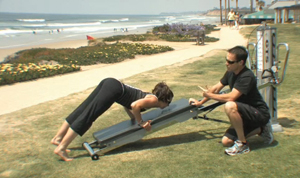
DUCK DIVING – Dive Bomber.
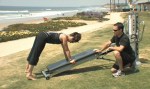
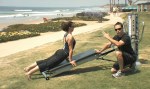
This exercise replicates duck diving under a wave or popping up on a surfboard. It could be likened to a pike, however it is quite different. The starting position has the heels raised and a neutral core position. The client ducks down towards the board, and moves into back extension. This translates into functional strength for surfers ducking under waves.
__________________________________________________________________________
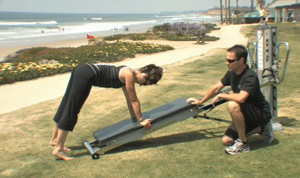
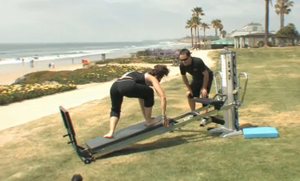
POPPING UP – Prone to Quadraped.
While it is not safe to pop up to a standing position on the glideboard, you can pop up to a Quadraped position which is still a great stability challenge. Direction comes from the trainer (call out “pop up!”). A great method is to have the athlete performing a swimming motion on the glideboard lying prone (left), then the trainer calls and the athlete moves into the quadraped position (right).
__________________________________________________________________________
POPPING UP – Drop Squat.
While there are a number of squat variations that can be performed on Total Gym, all ideal for lower body functional strength for a surfer, the drop squat in particular is unique as it mimics the concept of popping up and landing in a flexed position. It also protects the knees while still providing the necessary challenge required. This is different to a normal squat in that the knees pop up, then land in a neutral position as the feet land on the squat stand. Holding additional weights at the upper body increases the challenge.
__________________________________________________________________________
CORE – Jack Knife.
With the SCRUNCH® accessory, you can achieve an incredible core-targeted workout. SCRUNCH® elevates core training by allowing the athlete to stretch, strengthen and stabilise the entire core and trunk for a targeted abdominal workout. This is of great benefit to the surfer who needs to acheive optimal core strength to effectively manoeuvre the surfboard.
__________________________________________________________________________
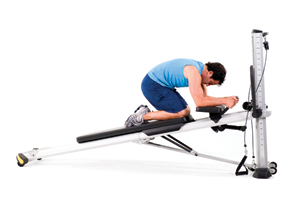
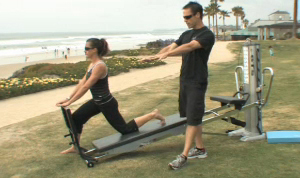
STRETCHES – Hip Flexor
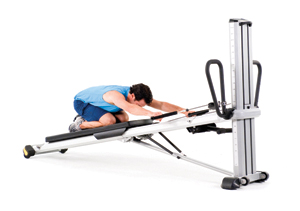
There is a lot of shortening of the abdominals and hip flexors with the SCRUNCH exercise, so Total Gym allows the athlete to round out again by assisting an incredibly effective and deep hip flexor stretch. The glideboard allows for a dynamic stretch option so the athlete can move deeper and deeper into the stretch as required.
__________________________________________________________________________
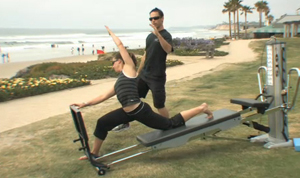
STRETCHES – Hip Flexor with Reach
The Hip Flexor stretch can be modified into a 3-dimensional stretch by adding arm drivers in the sagittal plane, frontal plane and transverse plane. This offers an incredible variation with the movements, opening up the entire body and rounding everything out again.__________________________________________________________________________
MOBILISATION – Foam Roller (Vertical and Horizontal)
A surfer is often in a flexed position and the spine will relish a release. Horizontal and vertical mobilisation is incredibly effective for this using the correct sized foam roller (100mm diameter). Click here to download a Foam Roller article for more about this.










MODIFICATIONS
Total Gym is an exciting piece of equipment due to the diversity and endless possibilities. Not only can this single piece of equipment achieve well over 200 exercises, you can add other training tools to enhance an exercise or further increase the exercise possibilities.
- For enhanced strength incorporate Dumbbells, Kettlebells, Medicine Balls, Weight Bar, Plates, and more.
- For increased functional stability incorporate a Suspension Training tool or Cable Machine.
- For stability challenges incorporate BOSU, DuraDisc, or any other unstable platform to use with Total Gym.
The glideboard is also adjustable – it be positioned from an incline to a horizontal position to act as a bench and it can be positioned at the ground level for evolved Pilates work.
The possibilities are endless. The rest I will leave up to your imagination!
SUMMARY
The exercise prescription for surfers to achieve their goals needs to be functional, compound movements that challenge the entire body to achieve the necessary levels of strength, mobility and flexibility. And, most importantly, these need to translate directly over to the movement patterns of surfing. If you’re a Total Gym owner – then you’ve got a great way to achieve this.
Click here to download this article in PDF format and view a breakdown of each exercise including more images and progression options.
Shara Curlett
Shara began her career in the fitness industry at Les Mills Dunedin in 2005 and from there combined her passion for fitness with her strength in business to create a niche role for herself specialising in “the business of fitness”. Shara has consulted for gyms and small studios, developed an indoor cycling program, and continues to work one on one with fitness business owners as a sideline passion. As business development and marketing manager for HQH Fitness, Shara is focused on business development, company strategy and marketing.

 HQH Fitness Blog
