Use Jumping for Better Sports Performance or For Improving specific aspects of better health

Plyometric exercises are powerful aerobic exercises used to increase your speed, endurance, and strength. They require you to exert your muscles to their maximum potential in short periods of time. Also known as jump training, plyometric exercises are usually geared toward highly trained athletes or people in peak physical condition. However, they can also be used by people wishing to improve their fitness. Plyometric exercises can cause stress to the tendons, ligaments, and lower-extremity joints, especially the knees and ankles. It’s important that you have the strength and fitness level necessary to do these exercises safely and effectively. If you’re adding plyometric exercises to your workout routine, work up to them gradually. Slowly increase the duration, difficulty, and intensity of the exercises. Some of the benefits of plyometric jumping include increased vertical jump height and long jump distance.

 Plyometric training can also help improve everything from jumping and sprinting ability to lower body strength. Studies have shown that plyometric training improves strength, muscle size and muscle speed, alongside improving coordination.

 Jump training—or plyometrics—creates improvement in sprinting, reactive strength, and running economy in shorter distances from 2K (1.2 miles) to 5K (3.1 miles), new research shows.  High knee skips, step-ups onto a box, jumping in and out laterally, and using an agility ladder are all effective plyometric moves.  If you’re just getting started, ease into this type of training gradually to avoid injury.  If you want to become a better runner, running needs to be a part of your regular routine, of course. But, according to new research in the Journal of Sports Sciences, you can benefit from jump training, too.

 Researchers looked at 21 studies that included 511 participants total, encompassing different strategies for improvements in time-trial performances—specifically, what helped in boosting effectiveness in shorter distances from 2K (1.2 miles) to 5K (3.1 miles).

They found that runners who consistently engaged in jump training saw improvement in sprinting, reactive strength, and running economy—which all led to better fitness and performance.  This is true for older runners as well, despite the widespread belief that jumping creates higher injury risk for joints as you age. Two of the study’s researchers published research in 2018 that looked at healthy adults over age 50 who used jump-training sessions with at least 60 seconds of recovery between sets. They concluded that jump training is safe and effective for these athletes, as long as they keep it under three sessions per week.  “Jumping, also called plyometric training, can be very beneficial for runners,” physical therapist Jason Kart, D.P.T., owner of Core Physical Therapy in Chicago, told Runner’s World. • Kart said this type of training improves your ability to generate power—not just in terms of muscular force, but also in your neurological system. Basically, you’re training your nervous system to ramp up faster and more effectively.

Jump training is a type of plyometric training that can help improve athletic performance. Plyometric exercises are powerful aerobic exercises used to increase your speed, endurance, and strength. They require you to exert your muscles to their maximum potential in short periods of time. Also known as jump training, plyometric exercises are usually geared toward highly trained athletes or people in peak physical condition. However, they can also be used by people wishing to improve their fitness.  Jump training can help improve power output, speed, agility, and vertical jump height. It can also help improve running economy and reduce the risk of injury.

Jump Training in Medical Rehabilitation

“Ballistic strength training” or Plyometric Jump Training, for people with traumatic brain injury (TBI) is a type of exercise that involves rapid movements such as jumping and throwing. The aim of this multi-centre trial was to implement ballistic strength training for people with TBI during the early recovery phase post-injury, targeted to the three main muscle groups responsible for forward propulsion when walking. Improving mobility after traumatic brain injury with ballistic strength training (unimelb.edu.au).

Jumping is a weight-bearing exercise that can help prevent osteoporosis and slow bone loss. Plyometric training is a type of exercise that involves explosive, powerful exercises that are trained to activate the quick response and elastic properties of the major muscles. It causes the participant to exert a high degree of force for a short period of time. Examples include exercises like jumping, skipping, and hopping. A study of post-menopausal breast cancer survivors demonstrated improved bone mineral density (BMD) at the hip and prevented BMD loss at the spine with a program that included jumping and resistance training. Another study of osteoporotic men engaged in either resistance training or progressive jump training found increases in BMD of the whole body and lumbar spine.

Best Solution: The Total Gym Jump Trainer

The Total Gym Jump Trainer is a jump exercise machine that builds explosive power and develops lower body muscle mass with two primary movements, the squat and the squat jump. It is designed to facilitate plyometric jumping exercises leveraging both linear bodyweight resistance and variable band resistance. The Total Gym Jump Trainer produces both concentric and eccentric loading of the muscles – allowing users to accelerate and decelerate quickly during a squat jump in a safe, controlled manner.

It’s clear from the information provided that plyometric jump training, also known as ballistic strength training, has numerous benefits for various populations. Here’s a summary of the benefits:

  1. Improved Athletic Performance: Plyometric jump training can enhance sprinting, reactive strength, running economy, power output, speed, agility, and vertical jump height. This type of training is valuable for athletes participating in running, field sports like rugby, soccer, basketball, volleyball, and others.
  2. Improved Muscle Strength and Size: Plyometric training improves strength and muscle size, especially in the lower body. It targets the major muscle groups responsible for forward propulsion during walking, making it beneficial for post-traumatic brain injury (TBI) patients during the early recovery phase.
  3. Bone Health: Jumping, which is a weight-bearing exercise involved in plyometric training, can help prevent osteoporosis and slow down bone loss. Studies have demonstrated improved bone mineral density (BMD) in post-menopausal breast cancer survivors and osteoporotic men engaged in jump training.
  4. Neurological Benefits: Plyometric jump training not only increases muscular force but also trains the nervous system to generate power more effectively. It enhances coordination and neuromuscular efficiency.
  5. Rehabilitation and Physical Therapy: Plyometric training can be used in physical therapy and medical rehab settings, including in cases of traumatic brain injury (TBI), Cerebral Palsy and ACL/MCL injuries.

Caution: It’s essential to note that while plyometric exercises offer various benefits, they also come with the risk of stress and potential injury to tendons, ligaments, and lower-extremity joints, especially the knees and ankles. Therefore, it’s crucial to approach plyometric training gradually and with appropriate fitness levels to ensure safety and effectiveness especially one involving high-impact activities like plyometrics.

That’s another reason why the Total Gym Jump trainer is well suited. It allows specific and safe control of Jump height, intensity, and range of movement.

Greg Doherty CEO HQH Fitness

Introducing the Total Gym and ELEVATE Jump Trainer

Take Your Fitness to New Heights with Plyometric Jump Training!

Are you looking to elevate your fitness routine and unleash your full athletic potential? Look no further than the revolutionary Total Gym Jump Trainer! Designed to cater to all age groups, this cutting-edge fitness equipment will take your workouts to new heights with the power of plyometric jump training.
The Total Gym Jump Trainer is not just any ordinary fitness machine – it’s a game-changer that will transform the way you exercise. Plyometric training, often referred to as “jump training,” is a dynamic and high-intensity workout technique that involves explosive movements to build strength, agility, and overall athleticism. With the Jump Trainer, you can easily incorporate plyometric exercises into your fitness regimen, unleashing a multitude of benefits for everyone from beginners to seasoned athletes.

Here are some of the incredible advantages of incorporating plyometric jump training into your routine:

  1. Boost Explosive Power: Plyometric exercises engage the fast-twitch muscle fibers, enhancing your ability to produce maximum force in minimal time. This leads to explosive power, making it an ideal training method for athletes involved in sports like basketball, soccer, volleyball, and track and field.
  2. Improve Cardiovascular Health: Jump training is a high-intensity workout that gets your heart pumping and blood flowing. As a result, it improves cardiovascular endurance, promoting a healthier heart and overall well-being.
  3. Burn Calories and Fat: If you’re looking to shed those extra pounds and tone your body, plyometric training can be your best friend. It’s a highly effective calorie burner, helping you achieve your fitness goals in less time.
  4. Enhance Coordination and Balance: By practicing plyometric exercises regularly, you’ll improve your neuromuscular coordination and balance. This not only benefits athletes but also helps older adults prevent falls and maintain independence.
  5. Joint-Friendly: Unlike traditional high-impact exercises, the Total Gym Jump Trainer minimizes stress on your joints, making it a safe and effective option for all ages.
  6. Versatility: The Total Gym Jump Trainer offers a wide range of exercises, from basic jumps to advanced plyometric variations. It’s suitable for everyone, regardless of fitness level or age, and can be easily adjusted to challenge or support individual needs.
  7. Fun and Engaging: Jump training is a dynamic and fun way to work out, keeping you motivated and excited about your fitness journey. Say goodbye to monotonous workouts, and hello to an enjoyable exercise routine!

Join the fitness revolution with the Total Gym Jump Trainer and experience the incredible benefits of plyometric jump training. Whether you’re an athlete looking to boost performance, a fitness enthusiast craving a new challenge, or a senior seeking to maintain an active lifestyle, this versatile equipment has something to offer you.

Don’t wait any longer to take your fitness to new heights! Embrace the power of plyometric training with the Total Gym Jump Trainer and elevate your workouts like never before. Experience the transformation in your body, mind, and overall athletic prowess. Act now and unleash the true potential within you!

Written by Greg Doherty CEO and Director of HQH Fitness.

BOSU – Balance for Tennis Performance

Gallery

This gallery contains 3 photos.

Written by Douglas S. Brooks, MS & Peter Twist, MSc The systems, strategies and tactics in tennis are best described as organized chaos. During a match, no competitor – even those with great on-court intuition – knows exactly what will … Continue reading

FIT JOINTS Series #3

by Dr. Theresa Dobson.

PART THREE OF THE “FIT JOINTS” SERIES

Introduction: Let’s begin with your posture.

STAND YOUR GROUND!

I literally and figuratively mean that. Posture is everything. How you stand and each step you take affects every joint in your body from the top of your head to the tip of your toes and all that lies in between. And here is why.

Gravity rules!

The minute we become bi-ped gravity begins its journey of push and pull down every joint in your body. Your platform for balance is your feet. They have the task of balancing your whole body upward against gravity keeping you from toppling ove. This alone seems an amazing feat not to mention the demands that occur when you decide to engage in multiple movements that sports and life require. Your body has built in mechanisms via the nerve system and joint system to accommodate your multi-directional demands quite gracefully – if your posture is intact. When your posture breaks down, uneven loading to your joints and spine begin – and injury and pain follow close behind.

So let’s explore the mechanisms of posture.

Ground Control:

Years of experience and thousands of postural assessments lead me to your feet. They reveal the secrets to how you stack upwards. Posture begins from the ground up, but can confront major challenges in today lifestyle which continually contract you down and forward such as computers, driving, cell phones, reading etc… These all force you into a forward contracted posture giving gravity momentum creating excessive loading and compensation through and including your organ systems all the way down to your toes.

Example; a minimal forward drop of the chin 2 centimetres equates to your normal 10 -12 kilo head weight becoming 17+ kilos (this commonly occurs while sitting at a computer). To ensure you don’t fall over with this additional load, the neck, shoulders, spine, hips, knees and feet all compensate and counterbalance this extra load. The longer the head maintains forward load, the harder the muscles and joints have to strain to maintain.

What a waste of energy!

Most jobs and sports require imbalanced loading to one side of your body making proper posture complicated and stressful to your whole system. Simple postural exercises can prepare your body to deal with these stresses and restack you evenly. Get your postural assessments from a professional and the rewards and benefits will last a lifetime.

Fact:

The foot has 26 bones, 33 joints, 107 ligaments and 19 muscles. WOW that is impressive! The toughest strongest and largest tendon in the foot is the Achilles, making it the longest and toughest to heal after injury. Those who have experienced this know it’s a big “Boo Hoo”! There are 125,000 sweat glands in each foot – yikes! So let those puppies breath!

Joint of The Month: The Foot / Ankle

The most frequently injured joint from sport is the ankle. The most common ankle injury occurs as the outside edge of the foot rolls over itself, lifting the arch of the foot and in turn tearing and damaging the outer ligaments.

Reoccurrence of foot and ankle injury is very high! Your feet must be rehabilitated properly to prevent this.

Create happy feet and prevent or rehab injury by training and stretching your feet in multiple directions and movement patterns. Yoga is great for this. Pick tramps with undulating terrain which challenge all angles.

The beach is also ideal. Kick off those boring shoes and do ABC’s in the sand (alternating heels and toes). Twirl and twist your feet in the sand – and give them a natural foot massage!

Dropped arches are a red flag to get yourself to a podiatrist where shoe inserts will assist.

On The Need to Know List:

“The World is Flat”. At least that is how your feet would interpret the western world of today – “A Flat Concrete Jungle!”

The amazing blueprint of your feet is designed for the ability to traverse across uneven terrain, stones, boulders and steep hills whilst keeping you stable and mobile. Today’s flat shoes and flat concrete jungle offer no challenge to the unique abilities of the feet and their intricate design.

The once “happy to meet a challenge” feet have now become lazy, collapsed, sore feet. When you take them for a walk, run or sporting event that slightly veers from flat you quickly find yourself with an injury.

So be kind to your feet and be playful with your feet  – because they have the big journey called “Your Life” to carry you through!

Fusion:

Sport offers you the gift of “complete presence” therein lies its sweet addiction and soul satisfaction. Your body gets to engage in the timeless space called “The Now” free of life’s tangles. Don’t let your busy calculating mind impose itself! Direct your mind as the tool in your sport, and let your body becomes the sport.

Next month’s FIT JOINT Series article will focus on the Hip.

Dr. Theresa Dobson

Doctor of Chiropractric, Neck Specialist, Neuromuscular Therapist, Biokinetics Practitioner, CHEK Holistic Lifestyle Coach Level II, Sports-Specific Practitioner and Seminar Presenter, Dr. Theresa Dobson has a long-standing rep utation as a highly experienced and knowledgeable practitioner. With two clinics located in Auckland and on the North Shore, Theresa works with a wide spectrum of patients such as professional rugby players, boxers, surfers, yachtsmen, cyclists, motor racers, soccer players, as well as recreational sportsmen and women of all age groups. Theresa is currently setting up a new business, guiding people through the “Dos and Don’ts” of surgery, offering programs and seminars to advise patients how to manage their pain effectively.
www.activecare.co.nz         www.stitchedup.co.nz
Theresa Dobson welcomes your emails at info@activecare.co.nz

FIT JOINTS Series #2:

by Dr. Theresa Dobson.

PART TWO OF THE “FIT JOINTS” SERIES

Introduction: Take Me to the River.

You wouldn’t typically think of your body as a river, though you probably should!

Your human vessel is composed of 70-80% water.

Every cellular function awaits the arrival of this liquid gold to perform the alchemy of generating life, energy and repairs that you body requires to stay alive.

Millions of chemical reactions occur every minute that require water. The joints of your body depend on water so blood can deliver much needed nutrients and escort ugly toxins and waste away.

Decreased water supply to your body is particularly vicious to your joints due to the fact that if toxins are milling around your organ system and there is not enough water to transport them to your bladder via the kidney, your body will use your joints as a garbage can for these toxins, thus detouring them away from your vital organs. This trade-off seems such a logical and smart compromise, but comes at a high cost.

Toxins stored in joints cause early degeneration with pain and breakdown close behind. Your luscious clear river has now become a swamp… Yikes!!

Hydration is one of the easiest economical ways to acquire healthy joints and a happy body overall. Grab that liquid gold and hydrate, hydrate, hydrate!

Each of you require different amounts of water based on how many cells you have, so here is an easy formula to know the right daily amount for you:

Take your body weight in kilos and multiply by .033, this is your personal perfect water intake amount.

Joint of the Month: Your Precious Knees

The largest joint in your body is the knee.

Classified as a hinge joint, your knee is the meeting point for your shin (tibia and fibula) and your upper leg (femur) which are all joined together via a barrage of ligaments to secure this precious joint.

Without this joint we could be walking on stilt legs (very unattractive), and most sports as we know them would be impossible!

The function and health of this joint is dependent on the balance of the pulleys and levers (muscles/tendons) that attach to it.

For instance, weak hamstrings and strong quads create excessive load to the ACL (anterior cruciate ligament): the most commonly injured ligament in the knee.

Balanced muscles, healthy ligaments and good posture are critical to this joint. So get yourself assessed via a length / tension assessment by a qualified professional, physiotherapist or CHEK practitioner.

Fact:

The knee is also the most complicated joint in your body! As it is a pivotal hinge joint that allows flexion (bending), extension (straightening) and small amounts of rotation, it is a ligament-filled joint. Those of you who have endured knee injuries and surgeries know these three lettered ligaments well: ACL, PCL, MCL and LCL. Injury to this joint is the reason most people visit orthopaedic physicians. It is also the joint most vulnerable to acute injury and osteoarthritis with the ACL is the most commonly injured ligament.

On Bended Knee

Most of our available leg movements and virtually all sports activities are dependent on your knees. They also support the whole upper body – so many thanks required!

Because your knees are in such high demand, they are also subject to a variety of injuries. In fact, knees keep most orthopaedic surgeons as busy as bees. Unfortunately many knee pre- or post-injuries are not rehabilitated properly and leave many people with the inability to fully extend (straighten) or flex (bend) your knees. This can not only be very frustrating but also compromises the rest of the body which has to compensate for your weakened knee.

Bless rather than curse your knees and prepare them for the demands you ask of them!

Because your knees are composed of ligaments not muscles, you must train and prepare them quite differently. The flat surfaces of our contemporary lifestyles provide no challenge to these ligaments and they become weak and prone to injury.

The knee should be trained in multiple movement patterns with slow held motions to excite and engage the ligaments, otherwise they can become unstable.

This joint is seriously challenged if your sport involves quick stopping or starting, changing directions or repetitive impact such as running, rugby, soccer netball, basketball, skiing, tennis or squash to name a few.

Individuals with flexible joints and hyperextension tendencies are especially vulnerable to knee problems so seek professional advise before engaging in a sporting activity.

Key Points to Remember:

  • Hydrate, hydrate, hydrate.
  • Train and rehabilitate to address the ligaments not just the muscles.
  • Seek professional advise and have a length tension assessment.
  • Get your spine checked to ensure postural imbalances are addressed.
  • Visit my webpage for more information or inquiries: http://www.activecare.co.nz

Fusion:

Create your perfect sporting moment…where your body, mind and soul smile. Breath into that moment and feel the magic. Then do it again… and again!

Next month’s FIT JOINT Series article will focus on the Foot-Ankle.

Dr. Theresa Dobson

Doctor of Chiropractric, Neck Specialist, Neuromuscular Therapist, Biokinetics Practitioner, CHEK Holistic Lifestyle Coach Level II, Sports-Specific Practitioner and Seminar Presenter, Dr. Theresa Dobson has a long-standing rep utation as a highly experienced and knowledgeable practitioner. With two clinics located in Auckland and on the North Shore, Theresa works with a wide spectrum of patients such as professional rugby players, boxers, surfers, yachtsmen, cyclists, motor racers, soccer players, as well as recreational sportsmen and women of all age groups. Theresa is currently setting up a new business, guiding people through the “Dos and Don’ts” of surgery, offering programs and seminars to advise patients how to manage their pain effectively.
www.activecare.co.nz         www.stitchedup.co.nz
Theresa Dobson welcomes your emails at info@activecare.co.nz

Surfing Your Way To Success With Total Gym

Inspired by summer creeping up around the corner and a couple of fantastic surfing videos on the new-look Total Gym website, this month I decided to write an article for our Total Gym owners – how to use Total Gym to train surfers. Many of the exercises came from GRAVITY Master Trainer Jeff Groh, which you can view on the Total Gym website.
Click here to view videos (note: these are alphabetical – click the right arrow twice to get to ‘S’). The models in the pictures below are Nicole Decker, Rob Glick and Jeff Groh.

Total Gym and Surfing

Surfing is so much more than just “getting up on the board.” And when it comes to competitive surfing – that is a whole other playing field. A very specific functional strength is required to replicate the movement patterns of surfing. The primary ones being:

  • Paddling
  • Duck Diving
  • Popping Up
  • Manoeuvres on the Board (requires a strong core for stability / balance)

To achieve functional strength, the muscles of the upper body, lower body and core have to be trained in a way that translates directly over to the sport in a synergistic manner. While isolation in some cases is necessary (core, beginner, rehab, etc.), primarily the athlete should be trained using exercises that challenge a combination of muscles – to replicate how they are challenged while surfing. This is necessary to improve or get the edge on a competitor…and is what separates the winners from all others.

Space/Time Saving Solution

As a personal trainer you want to give your client the most effective workout possible. However the time spent changing machines and moving to different areas within a room eats up time and disrupts what should be a time-efficient yet still challenging experience – particularly with professional athletes.

Total Gym ticks all the boxes because it enables you to work within a small area (a “pod”), maximising both your time and your client’s. In regards to the surfer it offers stability challenges, has core integration in most exercises, offers seamless strength transitions and near-unlimited advancements to ensure continued progression. Total Gym has incredible functional applications to almost any sport, and when it comes to surfing it is ideal for replicating many of the real-life actions of the sport.

And you don’t need to be an expert at surfing – you just need to understand the movement patterns and functional strength required to develop in the sport. Not sure what functional strength is exactly? Click on this link to read a great article by friend and colleague Dean QuirkeUnderstanding the Principles of Functional Training.

The added benefit of Total Gym is it is the perfect training tool not only for able-body surfers, but also surfers who have some kind of limitation or disability and are restricted by the equipment they can use.

Examples of Exercises to Benefit Surfers using Total Gym

Following are some functional exercises for the surfer using Total Gym. As we lead into summer there are loads of opportunities to start developing programs and promoting to attract novices who are ready to get back on the board or professionals who want a leading edge.

PADDLING – Surfer Lat Pull.


This popular exercise is a great way to challenge the lats/back while integrating the core, increasing the strength and endurance required for paddling out, or just prior to catching a wave (modification-high kneeling).

__________________________________________________________________________

PADDLING – Swimmer.

Strengthen the back musculature and arms in a swimming motion for muscle endurance. The unique thing about Total Gym is the glideboard – allowing the surfer to replicate the movement with resistance.

__________________________________________________________________________

PADDLING – Prone Reverse Fly with Back Extension.

Again, strengthen the back musculature with another great exercise. This position has more focus on scapula retraction and shoulders. Incorporate as little or as much back extension as the client needs.

__________________________________________________________________________

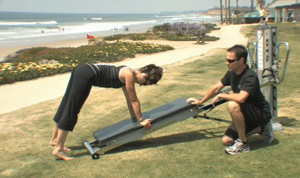
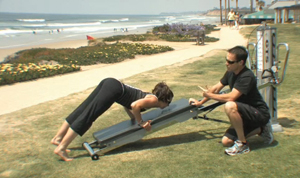
DUCK DIVING – Dive Bomber.

This exercise replicates duck diving under a wave or popping up on a surfboard. It could be likened to a pike, however it is quite different. The starting position has the heels raised and a neutral core position. The client ducks down towards the board, and moves into back extension. This translates into functional strength for surfers ducking under waves.

__________________________________________________________________________

POPPING UP – Prone to Quadraped.

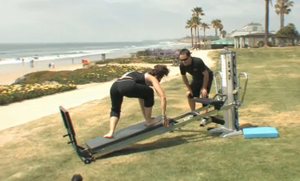
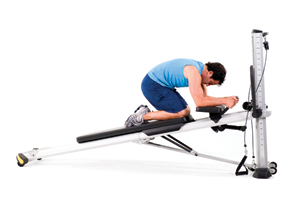
While it is not safe to pop up to a standing position on the glideboard, you can pop up to a Quadraped position which is still a great stability challenge. Direction comes from the trainer (call out “pop up!”). A great method is to have the athlete performing a swimming motion on the glideboard lying prone (left), then the trainer calls and the athlete moves into the quadraped position (right).

__________________________________________________________________________

POPPING UP – Drop Squat.

While there are a number of squat variations that can be performed on Total Gym, all ideal for lower body functional strength for a surfer, the drop squat in particular is unique as it mimics the concept of popping up and landing in a flexed position. It also protects the knees while still providing the necessary challenge required. This is different to a normal squat in that the knees pop up, then land in a neutral position as the feet land on the squat stand. Holding additional weights at the upper body increases the challenge.

__________________________________________________________________________

CORE – Jack Knife.

With the SCRUNCH® accessory, you can achieve an incredible core-targeted workout. SCRUNCH® elevates core training by allowing the athlete to stretch, strengthen and stabilise the entire core and trunk for a targeted abdominal workout. This is of great benefit to the surfer who needs to acheive optimal core strength to effectively manoeuvre the surfboard.

__________________________________________________________________________

STRETCHES – Hip Flexor

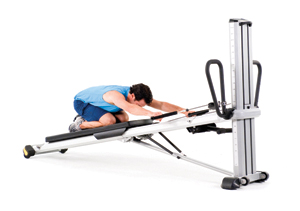
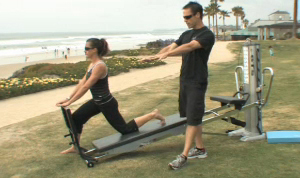
There is a lot of shortening of the abdominals and hip flexors with the SCRUNCH exercise, so Total Gym allows the athlete to round out again by assisting an incredibly effective and deep hip flexor stretch. The glideboard allows for a dynamic stretch option so the athlete can move deeper and deeper into the stretch as required.

__________________________________________________________________________

STRETCHES – Hip Flexor with Reach


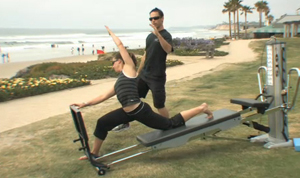
The Hip Flexor stretch can be modified into a 3-dimensional stretch by adding arm drivers in the sagittal plane, frontal plane and transverse plane. This offers an incredible variation with the movements, opening up the entire body and rounding everything out again.

__________________________________________________________________________

MOBILISATION – Foam Roller (Vertical and Horizontal)

A surfer is often in a flexed position and the spine will relish a release. Horizontal and vertical mobilisation is incredibly effective for this using the correct sized foam roller (100mm diameter). Click here to download a Foam Roller article for more about this.

MODIFICATIONS

Total Gym is an exciting piece of equipment due to the diversity and endless possibilities. Not only can this single piece of equipment achieve well over 200 exercises, you can add other training tools to enhance an exercise or further increase the exercise possibilities.

  • For enhanced strength incorporate Dumbbells, Kettlebells, Medicine Balls, Weight Bar, Plates, and more.
  • For increased functional stability incorporate a Suspension Training tool or Cable Machine.
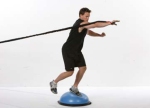
  • For stability challenges incorporate BOSU, DuraDisc, or any other unstable platform to use with Total Gym.

The glideboard is also adjustable – it be positioned from an incline to a horizontal position to act as a bench and it can be positioned at the ground level for evolved Pilates work.

The possibilities are endless. The rest I will leave up to your imagination!

SUMMARY

The exercise prescription for surfers to achieve their goals needs to be functional, compound movements that challenge the entire body to achieve the necessary levels of strength, mobility and flexibility. And, most importantly, these need to translate directly over to the movement patterns of surfing. If you’re a Total Gym owner – then you’ve got a great way to achieve this.

Click here to download this article in PDF format and view a breakdown of each exercise including more images and progression options.

Shara Curlett
Shara began her career in the fitness industry at Les Mills Dunedin in 2005 and from there combined her passion for fitness with her strength in business to create a niche role for herself specialising in “the business of fitness”. Shara has consulted for gyms and small studios, developed an indoor cycling program, and continues to work one on one with fitness business owners as a sideline passion. As business development and marketing manager for HQH Fitness, Shara is focused on business development, company strategy and marketing.